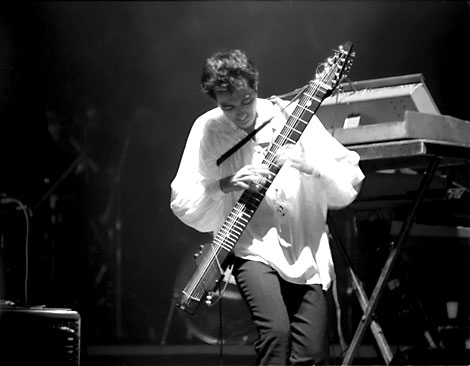
at musical convention

| Shaking a Stick at musical convention |
|
| Progression:
What guitarists, bands and music did you listen to as a young musician
in Argentina? Cides: "One of my theories for musicians that speak a different language other than English is that we listen to our favorite artists without understanding a lot of what they are saying while singing. For this reason, we pay more attention to the sounds of their voices and that of the instruments. When you grow up basically listening to sounds, your ear trains in a different way other than when your attention is caught by the lyrics of the song you are listening to." "You could say that musicians that don’t speak English become in a way, more “instrumental” musicians. Consequently, the reasons that certain bands became my favorites had more to do with their sounds than their lyrics. Bands like The Cure, Siouxsie and the Banshees, the guitar of Lou Reed, Frank Zappa, Bowie or The Damned – they had sounds that really caught my attention. On the other hand, I like very much the lyrics of the popular songs from my country, Argentina – like tango lyrics or those indigenous of the North. That’s also rock’n’roll!" |
"So, I come back
the next day and I remove this note and then feel really happy about it.
Possibly, a lot of people would think that I’m crazy or something,
but the truth is that I cannot understand art without a commitment of this
nature. The artists that have caught my attention the most are those that
live only for their art. I envy those artists that during their whole life
are totally committed and involved in their art, hour by hour. European
life does not afford this to many – that is, to allow an artist to
do their art full time, but I believe that this should be the life of a
real artist." "The equipment I use to record is the most rustic and traditional you can imagine. I recorded a tribute to Bach with an old 8-track adat that I rented while I was living in Holland. I played the violin sounds with volume pedals and I achieved the “bow effect” on the strings with a wooden spoon. I had no samplers or midi equipment. A lot of people who listen to this album do not believe it is a Stick, but it is! With the Stick, I was able to play clavichords, harpsichords and all that you need for violin works by Bach." |
||
|
|||
| Progression:
From idea to recorded tracks, what is your artistic process? Cides: "My way of recording is unusual – at least is seems so to me – because I see myself very involved in a kind of “obsessive fever” during the whole recording process of one song. In fact, recordings are a very difficult time. It’s not what fans would probably imagine – that you are trying to make a painting and you are excited and happy and inspiration comes through in a magical way and then…..you paint a line! Haha! It is more like a process of internal catharsis and I can’t help but record within the music the very essence of who I am. Every note and strike becomes something very important. Sometimes I go to sleep thinking that this or that note shouldn’t be there" |
Progression:
Will you speak of your Bach tribute album in comparison with your other
music? Cides: “My tribute to Bach was, in a political sense, a protest act of sorts. I was living in Holland at the time and I was angry at all the record companies and the commercial goals that accompany all the different “tributes” to artists no longer living. So, my idea was that I would record a dream that had been in my head for many years – to make a tribute to one of the finest composers of contemporary music, Johann Sebastian Bach. Actually, two dreams would be accomplished in this way. One, I could play my favorite works and make an album where nobody would profit economically being that the music is considered to be of “universal character” or “universal nature.” In other words, no company had rights to the works of Bach. Two, never before had this classical music been attempted on the Stick – emulating violins, cellos, clavichords – the whole orchestra, and I didn’t know exactly how it should sound. I was finding my way while I was playing the works. That’s where I encountered rock and popular music! Have you listened to the allegro of the BWV 1048? It’s incredible! That’s rock’n’roll!" |
||
© Progression • Winter
2006 |
|||
| < preview page | |||